



Emergency medical services face unpredictable disruptions from natural disasters, pandemics, equipment failures, and staffing shortages. Without robust continuity of operations planning, these challenges can cascade into service gaps that endanger community safety. EMS leaders need proven frameworks to maintain critical functions during crises while adapting to evolving threats. This guide delivers actionable strategies grounded in FEMA standards, real-world resilience research, and lessons from recent emergencies to help you build operational resilience that protects both your team and the communities you serve.
Table of Contents
- Key takeaways
- Understanding EMS continuity of operations planning frameworks
- Building resilient EMS strategies for operational continuity
- Communications and interoperability challenges in EMS continuity
- Applying lessons from recent crises to improve EMS operational resilience
- Enhance your EMS system continuity with expert consulting
- Frequently asked questions
Key Takeaways
| Point | Details |
|---|---|
| COOP Framework Alignment | EMS COOP should align with FEMA CPG 101 planning steps and use base plans, functional annexes, and hazard specific appendices. |
| MEFs and BIA Defined | Define Mission Essential Functions and conduct a Business Impact Analysis to guide recovery time objectives and resource allocation. |
| Interagency Coordination | Multiagency coordination and interoperability strengthen resilience by enabling mutual aid and shared situational awareness during disruptions. |
| Testing and Exercises | Regular testing through quarterly tabletop exercises and after action reviews reveals gaps and drives continuous improvement. |
Understanding EMS continuity of operations planning frameworks
Effective continuity planning starts with understanding proven frameworks designed specifically for emergency services. EMS Continuity of Operations integrates FEMA’s CPG 101 planning steps including risk analysis, operational assumptions, resource demands, and whole community coordination through base plans, functional annexes covering Emergency Support Functions, and hazard-specific procedures. This structured approach ensures your agency addresses all critical planning elements systematically rather than reacting to crises without preparation.
The foundation of any COOP plan begins with identifying Mission Essential Functions, the operations your agency absolutely must maintain during disruptions. For EMS, these typically include emergency dispatch, timely response to life-threatening calls, patient assessment and treatment, safe transport, and hospital coordination. Once you define MEFs, conduct a Business Impact Analysis to understand how long each function can be disrupted before causing unacceptable consequences. This analysis drives your recovery time objectives and resource allocation decisions.
Healthcare COOP templates emphasize Mission Essential Functions, Business Impact Analysis, alternate sites, devolution, and regular testing for EMS and hospitals. These templates provide tested frameworks you can adapt rather than building plans from scratch. They address succession planning, alternate facility identification, vital records protection, and devolution of authority when primary leadership becomes unavailable. The templates also stress documentation standards that ensure your plans remain accessible and actionable during actual emergencies.
Your COOP structure should include a base plan outlining overall philosophy and authorities, functional annexes addressing specific support areas like communications or logistics, and hazard-specific appendices for scenarios like pandemics or mass casualty incidents. This modular approach allows you to activate relevant sections without overwhelming responders with unnecessary information during time-sensitive situations.
Pro Tip: Schedule quarterly tabletop exercises focusing on different COOP components. Rotate through communications failures, facility loss, staffing shortages, and supply chain disruptions to build comprehensive organizational muscle memory.
Regular testing validates whether your written plans translate to effective action under pressure. Exercises reveal gaps in coordination, resource shortfalls, and procedural ambiguities that desk reviews miss. After each exercise or real activation, conduct structured after-action reviews to capture lessons and update your emergency management plans accordingly. This continuous improvement cycle transforms COOP from static documents into living operational guides. Consider partnering with neighboring agencies during exercises to test mutual aid agreements and identify public safety system assessment opportunities that strengthen regional resilience.
Building resilient EMS strategies for operational continuity
Resilience requires moving beyond basic continuity plans to implement adaptive strategies that enhance your operational capacity before, during, and after disruptions. Resilient EMS strategies include an all-hazards approach, multi-agency SOPs, 4S surge capacity, telehealth, military-civilian partnerships, psychological support, and climate considerations. This comprehensive framework addresses the interconnected challenges modern EMS systems face rather than treating each threat in isolation.
The all-hazards approach prepares your agency for diverse emergencies by focusing on core capabilities that apply across scenarios. Instead of creating separate plans for every conceivable incident, identify common operational requirements like alternative communication methods, backup power, staff augmentation, and supply chain redundancy. This efficiency reduces planning burden while improving actual readiness because your team practices universal skills applicable to multiple situations.
Surge capacity planning centers on the 4S framework: Staff, Stuff, Space, and System. Staff strategies include cross-training personnel, establishing callback procedures, credentialing volunteers, and partnering with neighboring agencies for mutual aid. Stuff encompasses equipment caches, vendor agreements for rapid resupply, and inventory management systems that track critical supplies. Space planning identifies alternate operating locations, mobile treatment capabilities, and patient staging areas. System considerations address coordination mechanisms, communication protocols, and decision-making authorities during scaled operations.
Key resilience-building actions:
- Develop written standard operating procedures with neighboring EMS agencies covering resource sharing, unified command structures, and joint training requirements
- Implement telehealth capabilities allowing paramedics to consult with emergency physicians for treatment guidance, reducing unnecessary transports during surge conditions
- Establish formal agreements with military medical assets, private ambulance services, and interfacility transport companies to expand capacity quickly
- Create psychological support programs addressing responder stress, including peer support teams, mental health resources, and mandatory recovery periods after prolonged activations
- Assess climate-related risks specific to your region such as extreme heat, flooding, or wildfire smoke affecting both call volumes and operational capabilities
Pro Tip: Map your mutual aid relationships visually to identify coverage gaps and redundancy opportunities. Include response times, specialized capabilities, and activation procedures for each partner agency.
Communication resilience demands redundancy through the PACE model: Primary, Alternate, Contingency, and Emergency communication methods. Your primary system might be digital radio, with cellular as alternate, satellite phones for contingency, and runners as emergency backup. Test each layer regularly and ensure all personnel understand activation triggers. Strong interoperability in EMS prevents the communication breakdowns that frequently undermine otherwise solid operational plans. Develop clear public safety crisis communication workflows that specify who communicates what information through which channels during different emergency phases.

Effective operational risk reduction in EMS requires honest assessment of your vulnerabilities before crises expose them. Conduct annual risk assessments examining infrastructure dependencies, single points of failure, and capability gaps. Prioritize mitigation efforts based on likelihood and consequence, addressing your highest risks first even when solutions require significant investment or organizational change.
Communications and interoperability challenges in EMS continuity
Communication failures consistently rank among the most critical obstacles during EMS emergencies, yet many agencies discover interoperability gaps only when activating continuity plans under actual crisis conditions. NIMS and ICS mandate structured interoperability for EMS incident management, with challenges including radio governance and unified command requirements to avoid operational chaos. Understanding these frameworks and their practical limitations helps you design realistic communication strategies rather than relying on theoretical coordination that collapses under pressure.
Radio governance presents persistent challenges because different agencies operate on separate frequencies with varying access controls. Even when technical interoperability exists through shared channels or gateway systems, organizational policies often restrict usage to specific incident types or command levels. These limitations mean your COOP plans must account for communication delays, information bottlenecks, and coordination gaps that slow decision-making precisely when speed matters most.
Unified command structures distribute authority among multiple agencies responding to the same incident, clarifying roles while enabling coordinated action. However, implementing unified command in EMS requires pre-incident agreements on command post locations, decision-making protocols, and resource allocation authorities. Without these foundations, unified command becomes a theoretical concept rather than an operational reality.
Common communication obstacles and solutions:
- Incompatible radio systems: Invest in interoperable gateway technology or establish shared tactical channels with neighboring agencies
- Limited channel capacity during major incidents: Develop communication priority protocols and alternate methods for routine traffic
- Unclear reporting relationships: Create incident-specific organizational charts distributed during initial briefings
- Information overload: Designate communication liaisons filtering and prioritizing messages for command staff
| Communication Method | Advantages | Limitations | Best Use Case |
|---|---|---|---|
| Digital radio | Reliable, encrypted, wide coverage | Requires infrastructure, limited interagency access | Primary operational communications |
| Cellular/smartphone | Ubiquitous, data capable, familiar | Network congestion during disasters | Alternate coordination, data sharing |
| Satellite phone | Independent of ground infrastructure | Expensive, limited units, line-of-sight requirements | Contingency when other systems fail |
| Mobile data terminals | Reduces radio traffic, documentation capability | Depends on network availability | Routine dispatching, patient information |
Pro Tip: Conduct quarterly communication drills requiring agencies to switch between primary and backup systems without warning. This realistic practice reveals gaps that scripted exercises miss.
Achieving seamless EMS interoperability strategies requires both technical solutions and cultural change. Technical investments in compatible equipment and shared systems provide necessary infrastructure, but operational effectiveness depends on regular joint training, established relationships between agency leaders, and commitment to collaborative response over territorial protection of resources and authority. Schedule routine multi-agency planning meetings addressing upcoming events, seasonal challenges, and capability development to build the trust and familiarity that enable effective crisis coordination.
Applying lessons from recent crises to improve EMS operational resilience
Real-world emergencies provide invaluable data on how EMS systems perform under sustained stress, revealing both resilience strengths and critical vulnerabilities that paper plans overlook. The COVID-19 pandemic case study from Jena, Germany EMS reveals mission volume drops, increased on-site treatments, and extended hospital handover times indicating resilience gaps especially in hospital integration. These findings illustrate how disruptions cascade through interconnected healthcare systems, creating bottlenecks that standard capacity planning fails to anticipate.
During the pandemic’s peak, EMS agencies experienced paradoxical demand patterns. Overall call volumes initially dropped as people avoided seeking care, but acuity increased with more critical patients delaying treatment until conditions worsened. Simultaneously, transport times extended dramatically as hospitals struggled with capacity constraints, leaving ambulances waiting hours for patient handoff. This combination stressed EMS systems differently than mass casualty scenarios that drive traditional surge planning, highlighting the need for adaptive rather than purely absorptive resilience strategies.
Key pandemic impacts on EMS operations:
- Mission volume fluctuations ranging from 30% decreases to subsequent surges as delayed care needs emerged
- Increased on-scene treatment time as paramedics performed more assessments and interventions before transport decisions
- Hospital handover delays averaging 45-90 minutes in severely impacted systems, effectively removing units from service
- Supply chain disruptions for personal protective equipment, medications, and disinfection supplies
- Staffing shortages from illness, quarantine requirements, and psychological burnout
| Resilience Metric | Pre-Pandemic Baseline | Pandemic Peak | Improvement Strategy |
|---|---|---|---|
| Average response time | 8.2 minutes | 11.7 minutes | Implement system status management and dynamic deployment |
| Hospital handover time | 15 minutes | 78 minutes | Establish alternate patient destination agreements |
| Unit availability | 92% | 67% | Activate mutual aid agreements and reserve fleet |
| Staff illness rate | 3% | 24% | Enhance infection control and psychological support programs |
Pro Tip: Analyze your call data from 2020-2022 to identify specific resilience gaps your system experienced. Use these findings to prioritize COOP improvements addressing your actual vulnerabilities rather than generic threats.
Resilience encompasses both absorptive capacity, maintaining function during disruptions, and adaptive capacity, adjusting operations to meet changing demands. Absorptive strategies include equipment reserves, redundant facilities, and staffing depth that allow continued operations despite losses. Adaptive approaches involve protocol modifications, alternative treatment pathways, and flexible deployment models that optimize available resources for actual rather than anticipated conditions. The most resilient EMS systems combine both capacities, maintaining core capabilities while innovating to address novel challenges.
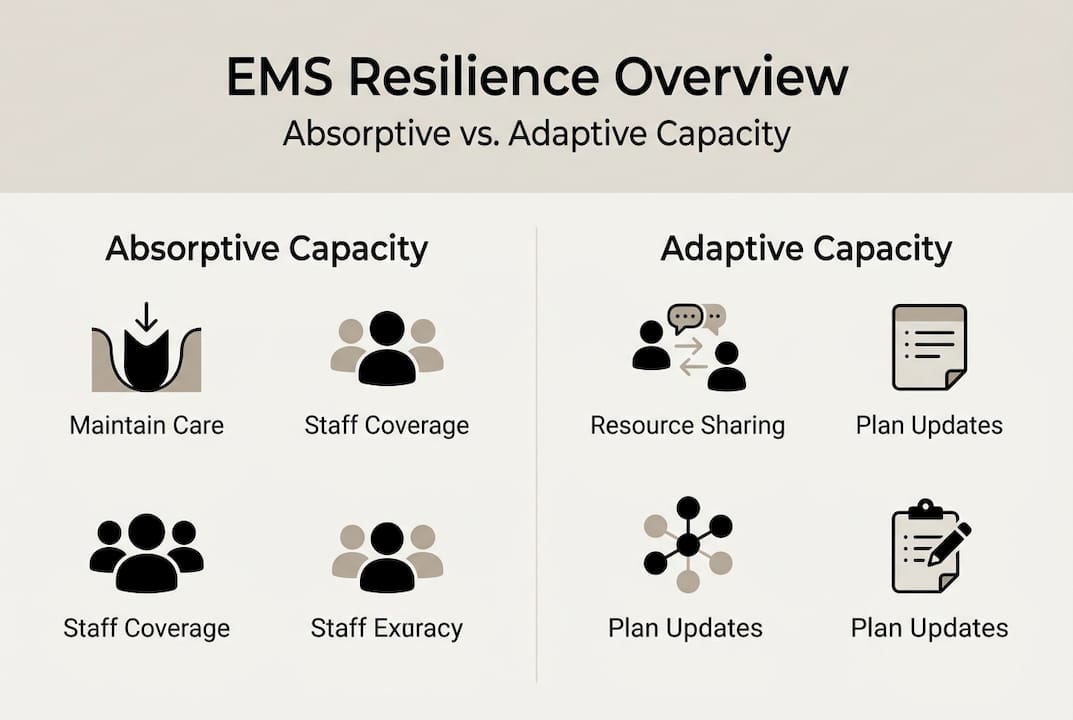
Mutual aid and resource sharing proved essential for mitigating system overload during prolonged crises. Agencies with formalized mutual aid in EMS agreements activated support more quickly and effectively than those attempting to negotiate assistance during emergencies. However, pandemic experience revealed that widespread simultaneous impact limits mutual aid effectiveness when all regional partners face similar stress. This reality emphasizes the importance of state and federal resource coordination, private sector partnerships, and non-traditional capacity sources like military medical assets or volunteer organizations.
Data-driven after-action reviews transform crisis experiences into operational improvements. Collect quantitative metrics on response times, patient outcomes, resource utilization, and system performance alongside qualitative feedback from personnel about what worked and what failed. Compare this evidence against your COOP assumptions to identify gaps between planned and actual performance. Update your continuity plans, training programs, and resource investments based on these findings rather than returning to pre-crisis operations unchanged. This learning cycle builds genuine resilience through continuous adaptation informed by real-world testing.
Enhance your EMS system continuity with expert consulting
Building robust continuity of operations requires specialized expertise that many EMS agencies lack internally, particularly when balancing daily operational demands with long-term resilience planning. The Public Safety Consulting Group brings decades of experience helping agencies design and implement comprehensive COOP frameworks tailored to their unique operational contexts, community needs, and resource constraints.
Our consultants work directly with your leadership team to assess current capabilities, identify critical vulnerabilities, and develop actionable strategies that enhance resilience without overwhelming your organization. We provide practical guidance on EMS system design that integrates continuity considerations from the ground up, system status management approaches that optimize resource deployment during disruptions, and mutual aid frameworks that ensure reliable support when you need it most. Partner with proven experts who understand both the theoretical frameworks and the operational realities of maintaining EMS service quality during crises.
Frequently asked questions
What is EMS continuity of operations?
EMS continuity of operations encompasses the plans, procedures, and capabilities that enable emergency medical services to maintain essential functions during disruptions. COOP addresses how agencies will continue emergency dispatch, response, patient care, and transport when facing facility damage, equipment loss, staffing shortages, or infrastructure failures. Effective COOP planning identifies Mission Essential Functions, establishes alternate operating procedures, and ensures coordination with healthcare partners and mutual aid resources.
How do EMS agencies define Mission Essential Functions?
Mission Essential Functions represent the critical operations that must continue during any disruption to fulfill the agency’s core purpose. For EMS, MEFs typically include receiving and processing emergency calls, dispatching appropriate resources, responding within target timeframes, providing patient assessment and treatment, safely transporting patients to appropriate facilities, and maintaining coordination with hospitals and other emergency services. Agencies prioritize MEFs through Business Impact Analysis examining consequences of function loss.
What communication strategies improve EMS continuity during incidents?
Effective incident communication relies on NIMS and ICS frameworks establishing unified command structures, clear reporting relationships, and standardized terminology across responding agencies. Implement PACE communication plans providing Primary, Alternate, Contingency, and Emergency methods ensuring connectivity when systems fail. Train personnel on interoperable communication systems before incidents, establish communication liaisons filtering information flow, and develop protocols prioritizing critical messages during high-volume situations. Regular multi-agency exercises identify and resolve interoperability gaps.
What lessons from the COVID-19 pandemic inform EMS COOP improvements?
The pandemic revealed that prolonged crises create different resilience challenges than acute mass casualty incidents, requiring both absorptive capacity to maintain operations and adaptive capacity to modify service delivery. Hospital integration emerged as a critical vulnerability when extended handover times removed ambulances from service for hours. Agencies should enhance supply chain redundancy, establish alternative patient destinations, implement telehealth capabilities for treatment guidance, and develop psychological support programs addressing sustained responder stress. Data-informed after-action reviews help adapt COOP plans for future crises based on actual performance gaps rather than theoretical assumptions.
Recommended
- Interoperability Without Surrender | The Public Safety Consulting Group
- EMS Strategic Planning Process for Successful Service Delivery
- Best Practices for EMS Instructors: Shaping the Future of Emergency Medical Services Education | The Public Safety Consulting Group
- Public Safety Definition: Impact on EMS Operations
- EMS Background Checks Cut Negligent Hiring 40% in 2026