



Faster is not always better. That assumption drives a surprising amount of EMS policy, yet the evidence tells a more nuanced story. For out-of-hospital cardiac arrest (OHCA), every minute without intervention reduces survival odds by 7 to 10%. But for certain trauma cases, extremely short prehospital times offer diminishing mortality benefits. Municipal leaders who understand this distinction are better positioned to build EMS systems that genuinely save lives, not just chase stopwatch metrics. This article breaks down the benchmarks that matter, the factors that shape response performance, and the evidence-based strategies your community can act on today.
Table of Contents
- Understanding EMS response time benchmarks and their real impact
- Key factors that influence EMS response times
- Proven strategies to improve EMS response efficiency
- Strategic planning: The municipal leader’s role in EMS response improvement
- Beyond response times: What really determines EMS success?
- How The Public Safety Consulting Group can help you improve EMS response
- Frequently asked questions
Key Takeaways
| Point | Details |
|---|---|
| Critical for survival | Shorter EMS response times are decisive for time-sensitive emergencies like cardiac arrest and trauma. |
| Many factors involved | Geography, call priority, resource availability, and technology all impact EMS speed. |
| Modern strategies work | Dynamic deployment, real-time dispatch, and data-driven planning consistently reduce delays. |
| Leadership matters | Municipal leaders can drive rapid improvement through strategic planning and stakeholder engagement. |
| Look beyond just speed | Measuring patient outcomes and system process quality delivers a true picture of EMS effectiveness. |
Understanding EMS response time benchmarks and their real impact
EMS response time is measured from the moment a 911 call is received to the moment the first unit arrives on scene. This interval captures dispatcher processing, unit notification, crew preparation, and travel time. It is the most commonly tracked performance metric in emergency medical services, but it is far from the only one that matters.
National standards set a clear baseline. EMS response benchmarks from NHTSA (National Highway Traffic Safety Administration) call for response under 8 minutes for 90% of life-threatening calls in urban areas, and NFPA (National Fire Protection Association) 1710 targets similar thresholds. The US national average hovers around 7 minutes in urban settings, while rural communities average closer to 13 minutes, a gap that carries real consequences.
| Setting | Benchmark target | US average response |
|---|---|---|
| Urban | Under 8 minutes (90% of calls) | ~7 minutes |
| Suburban | 8 to 12 minutes | ~9 minutes |
| Rural | No universal standard | ~13 minutes |
The stakes are highest for time-sensitive emergencies. OHCA survival drops 7 to 10% for every minute that passes without defibrillation or CPR. STEMI (ST-elevation myocardial infarction) patients also benefit significantly from rapid EMS arrival, which enables faster catheterization lab activation. Trauma, however, is more complex. Research shows that extremely short prehospital intervals do not consistently reduce mortality for trauma patients, partly because definitive care happens in the hospital, not the field.
“Response time is a process measure, not an outcome measure. A system that consistently hits 8 minutes but delivers poor clinical care is not a high-performing system.”
This distinction matters for strategic EMS planning. Leaders who treat response time as the sole indicator of system quality risk misallocating resources and missing broader performance gaps. Benchmarks are useful starting points, not finish lines.
Key factors that influence EMS response times
Knowing what slows ambulances down is just as important as knowing where you want to be. Response performance is shaped by a layered set of operational, environmental, and systemic variables.
Here are the primary factors that affect how quickly a unit reaches a patient:
- Call prioritization: Misclassified calls can send advanced life support (ALS) units to low-acuity incidents, leaving high-acuity patients waiting.
- Resource availability: When units are already committed, response times climb. High call volume with insufficient staffing creates a compounding delay effect.
- Geography and road infrastructure: Longer distances, single-access roads, and limited bridge crossings all add time that no amount of staffing can fully offset.
- Weather conditions: Ice, flooding, and reduced visibility slow unit travel and increase the risk of vehicle accidents.
- Traffic patterns: Urban peak-hour congestion can add 2 to 4 minutes to response times even when a unit is stationed nearby.
Predictive modeling for response using machine learning (ML) has emerged as a powerful tool for identifying these variables at scale. ML analysis can process historical call data, weather patterns, and resource constraints to support adaptive unit allocation before demand spikes occur.
Statistic callout: Units that are consistently busy (defined as unit hour utilization above 0.35) show measurable declines in response performance and crew readiness. Managing unit utilization is not just an efficiency issue; it is a patient safety issue.
Pro Tip: When assessing EMS response needs, pull at least 24 months of CAD (computer-aided dispatch) data to identify recurring response time failures by zone, time of day, and call type. Patterns are almost always present, and they point directly to where investment is needed.
Building a smarter EMS strategy optimization framework starts with understanding these variables in your specific service area, not applying a generic national template.
Proven strategies to improve EMS response efficiency
Once you understand what drives delays, the path to improvement becomes much clearer. The following strategies have demonstrated measurable results across diverse EMS systems.
- Dynamic deployment (System Status Management): Rather than stationing units at fixed locations, dynamic deployment moves ambulances proactively based on predicted demand. This reduces travel distance to the next call and keeps coverage balanced across zones.
- Computer-aided dispatch (CAD) upgrades: Modern CAD platforms process call information faster, apply evidence-based priority algorithms, and recommend the closest appropriate unit in real time. Outdated dispatch systems are a hidden drag on response performance.
- GPS and real-time unit tracking: Integrating GPS with CAD allows dispatchers to see exact unit locations and assign the nearest available resource accurately, not based on assumed position.
- Peak-hour staffing alignment: Scheduling additional units during historically high-volume periods, typically weekday mornings and early evenings, reduces the probability of all units being committed simultaneously.
- Strategic station and zone placement: Locating stations based on call density mapping rather than historical convention can shorten average travel times across an entire service area.
| Strategy | Primary benefit | Implementation complexity |
|---|---|---|
| Dynamic deployment | Reduces travel time | High |
| CAD system upgrade | Faster dispatch decisions | Medium |
| GPS integration | Accurate unit tracking | Low to medium |
| Peak staffing | Reduces unit saturation | Medium |
| Strategic station siting | Lowers average travel distance | High |
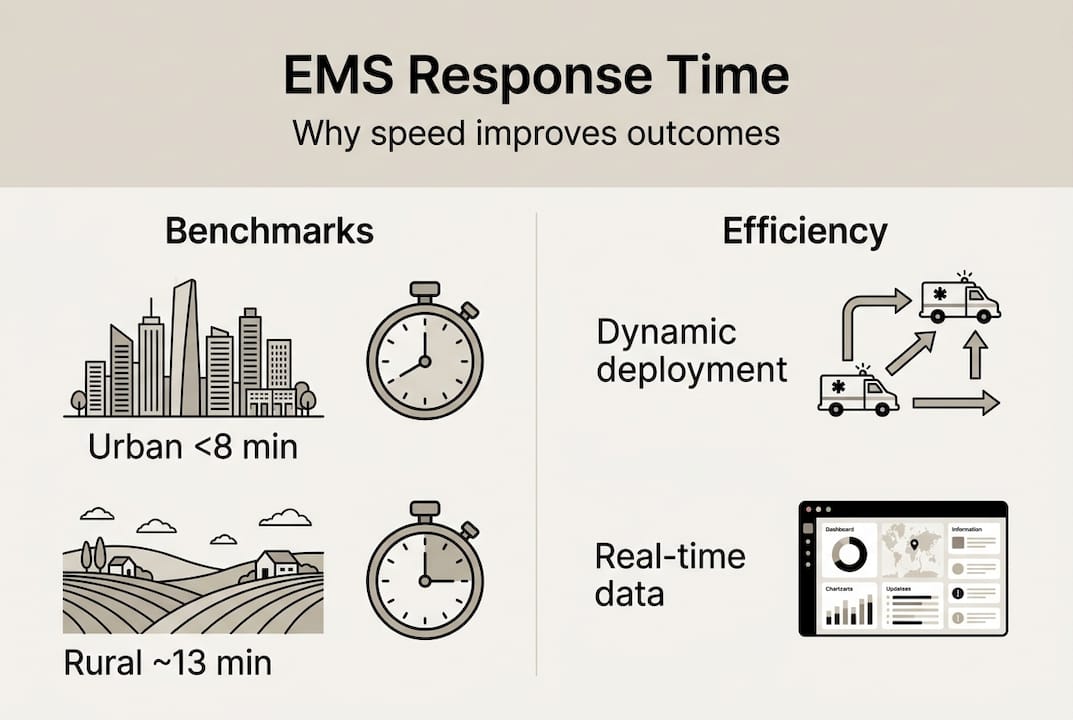
Dynamic deployment strategies work best when paired with strong data infrastructure. Without accurate, real-time information, proactive positioning becomes guesswork. Investing in modern CAD and dispatch systems is often the highest-leverage first step a municipality can take. Pairing that with broader public safety strategies ensures EMS improvements align with your community’s overall emergency response goals.
Strategic planning: The municipal leader’s role in EMS response improvement
Strategies only produce results when leaders commit to structured, sustained implementation. Municipal officials are not just budget approvers; they are the architects of EMS system performance.
Here is a practical framework for driving measurable improvement:
- Define your KPIs (key performance indicators): Response time is one metric. Also track unit hour utilization, call-to-dispatch interval, first-pass resolution rates, and patient outcome data where available.
- Engage stakeholders early: EMS medical directors, dispatch supervisors, union representatives, and hospital partners all hold information that shapes effective planning. Exclude them and you will miss critical operational realities.
- Set SMART goals: Specific, Measurable, Achievable, Relevant, and Time-bound targets give your team a clear direction. “Improve response times” is not a goal. “Reduce average urban response time from 9.2 to 8.0 minutes within 18 months” is.
- Balance speed with safety: Pressure to reduce response times can inadvertently encourage unsafe driving. Policies must explicitly address speed limits, intersection protocols, and vehicle operation standards to avoid trading one risk for another.
- Use empirical benchmarks to guide investment: The EMS planning best practices framework recommends anchoring decisions to the 8-minute urban standard while accounting for your community’s unique geography and call mix.
Pro Tip: Before committing to capital investments like new stations or vehicles, conduct a formal EMS needs assessment to confirm whether the gap is a resource problem, a deployment problem, or a process problem. The solution differs significantly depending on the root cause.
Reviewing EMS design case studies from comparable municipalities can also reveal what has worked elsewhere and help you avoid costly trial-and-error approaches. EMS strategic planning is not a one-time exercise; it is an ongoing discipline that requires regular data review and course correction.
Beyond response times: What really determines EMS success?
We have worked alongside enough municipal leaders to recognize a consistent pattern: the communities that improve fastest are not the ones obsessed with shaving seconds off average response. They are the ones that build systems designed to deliver the right care, at the right time, with the right resources.
Response time alone is insufficient for benchmarking system quality. A genuinely high-performing EMS system requires structure measures (staffing models, unit deployment), process measures (protocol adherence, dispatch accuracy), and outcome measures (patient survival, neurological recovery rates). Focusing narrowly on speed risks creating a system that looks good on paper but underperforms where it counts.
Rural communities face a particularly difficult reality. No realistic deployment model will get rural response times to urban benchmarks. The answer there is not faster driving; it is better first-responder integration, community CPR training, and telemedicine-assisted triage. Condition-specific targets matter too. An 8-minute benchmark is life-saving for OHCA but largely irrelevant for a low-acuity fall with no life threat.
We encourage leaders to pursue deeper EMS performance metrics that reflect the full complexity of their systems. Response time is the starting point of the conversation, not the end of it.
How The Public Safety Consulting Group can help you improve EMS response
For leaders ready to operationalize these insights, expert guidance makes the difference between incremental adjustments and lasting system transformation. At The Public Safety Consulting Group, we work alongside municipal leaders to build EMS systems grounded in data, designed for your community, and structured for long-term performance.

Explore our EMS system design examples to see how comparable communities have improved response performance. Review our EMS strategic planning resources to understand the full planning process, or download our municipal EMS strategy guide for a practical roadmap. Contact our team today to discuss a custom assessment for your jurisdiction.
Frequently asked questions
What is considered a good EMS response time in cities?
A response time under 8 minutes for 90% of critical calls is the standard in urban areas, per NHTSA and NFPA guidelines. Systems that consistently meet this threshold are generally considered to be performing at an acceptable level for life-threatening emergencies.
Do quicker EMS response times always mean lower death rates?
Faster response is critical for conditions like OHCA, but response time alone does not guarantee lower mortality across all call types. Clinical quality, protocol adherence, and hospital coordination all contribute significantly to patient outcomes.
What practical steps can cities take to shorten EMS response times?
Cities can implement dynamic deployment strategies, upgrade CAD systems, integrate GPS tracking, align staffing with peak call hours, and reposition stations based on call density data. Each of these interventions addresses a distinct source of delay.
How do rural EMS response times compare to urban areas?
Rural EMS response times average about 13 minutes, nearly double the urban average of approximately 7 minutes. This gap reflects geographic realities that require different strategies, not simply more units.
What other metrics should leaders consider besides response time?
Patient outcomes, unit hour utilization, dispatch accuracy, and protocol compliance are all essential indicators of system quality. A complete performance picture requires structure, process, and outcome measures working together.