



TL;DR:
- EMS QA/QI programs are data-driven systems to monitor and improve patient care quality.
- Effective programs involve medical director leadership, a non-punitive culture, and AI-assisted reviews.
- Leadership engagement and viewing QA/QI as a public safety investment drive real system improvements.
Structured EMS quality assurance programs can reduce clinical errors by 30% within 12 months, yet many municipal leaders still struggle to distinguish regulatory compliance from genuine quality improvement. This confusion costs agencies more than time. It costs patient outcomes. Whether you’re building a QA/QI program from scratch or evaluating an existing one, understanding the difference between checking boxes and driving real change is the foundation of effective EMS leadership. This guide breaks down the core definitions, practical methodologies, common pitfalls, and expert strategies that municipal decision-makers need to build EMS systems that deliver measurably better care.
Table of Contents
- EMS quality assurance defined: Core principles and regulations
- How EMS quality assurance works: Methodologies and benchmarks
- Building an effective EMS QA program: Key elements for municipalities
- Common pitfalls and expert strategies for quality assurance success
- Our take: Moving beyond compliance to real public safety impact
- Take the next step for better EMS quality and public safety
- Frequently asked questions
Key Takeaways
| Point | Details |
|---|---|
| QA/QI distinctly defined | Quality assurance monitors compliance with protocols while quality improvement proactively boosts EMS system performance. |
| Benchmarks reveal improvement needs | National measures like NEMSQA identify care gaps and guide targeted EMS enhancements. |
| Non-punitive culture and AI are critical | Modern QA programs succeed by fostering trust, embracing technology, and supporting continuous learning. |
| Avoid common pitfalls | Anticipate challenges like weak data integrity and legacy processes to ensure program success. |
| Leadership drives real impact | Municipal commitment beyond compliance delivers safer, higher quality emergency services for communities. |
EMS quality assurance defined: Core principles and regulations
With the foundation of why QA matters established, let’s clarify what it means and why the regulatory context matters for your municipality.
EMS quality assurance, often referred to as QA/QI, is a systematic, data-driven process to monitor, evaluate, and enhance the quality of patient care delivered by your EMS system. It is not simply a documentation requirement. It is an operational framework that, when implemented correctly, directly influences how your providers perform in the field.
One of the most important distinctions for any municipal leader to understand is the difference between QA and QI:
- Quality assurance (QA): Retrospective in nature. It looks back at completed patient care reports to evaluate whether protocols were followed, identify deviations, and document corrective actions.
- Quality improvement (QI): Proactive and forward-looking. It uses data trends and performance patterns to drive system-wide improvement before problems become patterns.
Both functions are essential, and most high-performing agencies treat them as two sides of the same coin. Regulatory frameworks reinforce this. Texas Administrative Code Section 157.11(n)(2), for example, mandates that licensed EMS providers maintain a written QA/QI plan that includes complaint tracking, corrective action procedures, and ongoing performance review. Many states have comparable requirements, and the specifics vary, but the intent is consistent: your agency must have a structured, documented system for evaluating and improving care.
| Element | Quality assurance | Quality improvement |
|---|---|---|
| Focus | Protocol compliance | System-wide performance |
| Timing | Retrospective | Ongoing and proactive |
| Goal | Identify deviations | Drive continuous improvement |
| Trigger | Specific case review | Data trends and benchmarks |
Two elements that consistently separate effective programs from ineffective ones are medical director involvement and a non-punitive culture. EMS medical oversight from a qualified physician is not optional in most states, and it should not be treated as a formality. Your medical director should be actively engaged in case reviews, protocol development, and corrective action decisions.
A non-punitive culture matters just as much. When providers fear discipline for reporting errors, your data becomes unreliable. When they trust the process, your data becomes a tool for growth. Complaint tracking, corrective action loops, and municipal EMS best practices all depend on honest, complete information flowing through the system.
“A QA/QI program is only as strong as the culture that supports it. Compliance without trust produces paperwork. Trust without compliance produces risk. You need both.”
How EMS quality assurance works: Methodologies and benchmarks
Now that we’ve clarified what EMS QA is and why it’s essential, here’s how it’s measured and the benchmarks that drive real improvements.
Effective QA/QI programs rely on a defined set of methodologies. Core methodologies include chart reviews, harm classification, multi-level case reviews, correction loop closure, and performance metrics aligned with NEMSQA and EMS Compass standards. Each element plays a specific role in the overall system.
Here is how a structured review process typically works:
- Chart review: Patient care reports are pulled and evaluated against protocol benchmarks. This can be done through sampling or, increasingly, through AI-assisted full-case analysis.
- Harm classification: Each flagged case is assigned a harm level (typically across five tiers, from no harm to serious patient harm). This prioritizes where clinical leadership focuses its attention.
- Multi-level review: Cases escalate through peer review, supervisor review, and medical director review depending on severity and complexity.
- Correction loop closure: Every identified issue must result in a documented corrective action, whether that’s education, protocol clarification, or a system change.
- Benchmarking: Performance is compared against national standards like NEMSQA measures to contextualize local results.
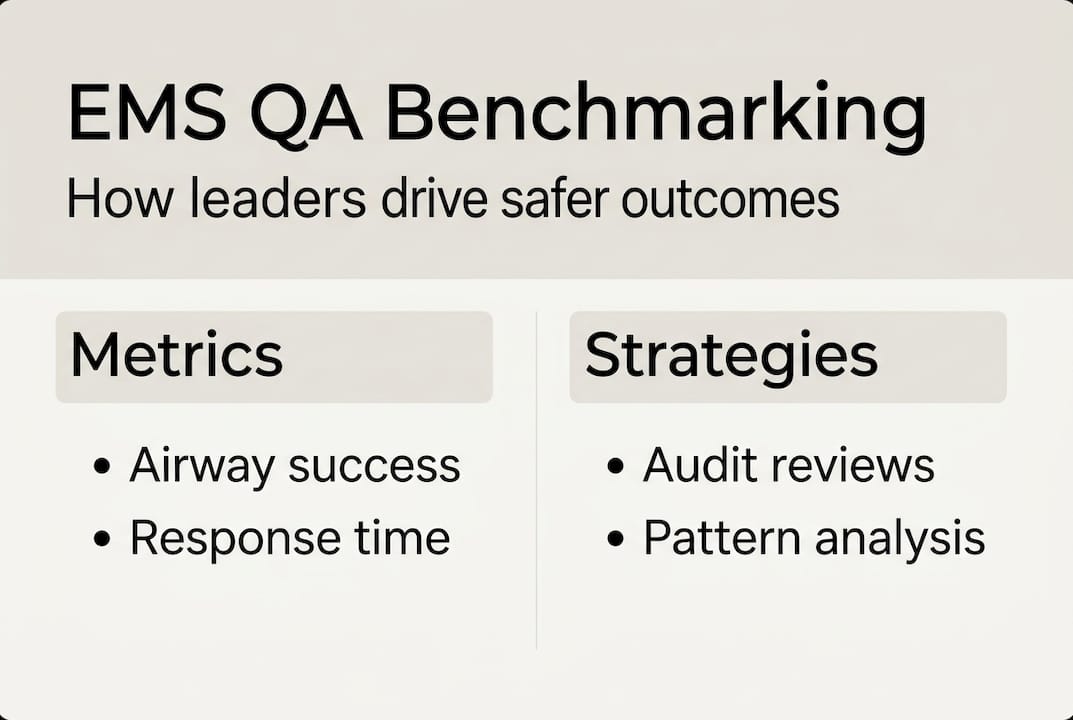
NEMSQA measures are particularly valuable for municipal leaders because they provide a national reference point. Take Airway-01, which tracks successful advanced airway management. National data reveals that some agencies achieve only 20 to 23% first-attempt success rates on advanced airways. That number, when benchmarked against your own data, tells you whether your training, protocols, or equipment need attention.
| NEMSQA measure | What it tracks | Why it matters |
|---|---|---|
| Airway-01 | Advanced airway success rate | Identifies intubation performance gaps |
| Cardiac-01 | CPR quality compliance | Tracks resuscitation protocol adherence |
| Pain-01 | Pain reassessment after treatment | Monitors patient-centered care quality |
Pro Tip: If your agency is still relying on random sampling for chart review, you’re working with incomplete data. AI-assisted review tools now allow agencies to cut clinical errors by analyzing 100% of patient care reports, giving you a far more accurate picture of system performance.

Paired with operational audits, benchmarking reveals patterns that individual case reviews often miss. The goal is not to find fault. It is to find opportunity.
Building an effective EMS QA program: Key elements for municipalities
With core processes and benchmarks explored, here’s what it takes to build and sustain a high-performing QA/QI system at the municipal level.
Building a compliant, effective program requires more than a written plan. It requires deliberate structure, active leadership, and the right tools. Here are the key elements every municipal EMS QA/QI program should include:
- Medical director leadership: Your medical director must lead the QA/QI program, not just sign off on it. This means participating in case reviews, guiding corrective actions, and shaping protocol updates based on performance data.
- Written QA/QI plan: Document your processes, responsibilities, review timelines, and corrective action procedures. This is both a regulatory requirement and an operational necessity.
- Complaint tracking system: Every complaint, whether from a patient, family member, or hospital staff, should be logged, investigated, and resolved with documented follow-up.
- Continuing education integration: Corrective actions should connect directly to your CE program. If chart reviews reveal a pattern of medication dosing errors, your next CE module should address it.
- Non-punitive improvement culture: As noted in the NAEMSP equity and quality management position statement, equitable and effective QA/QI depends on systems where providers feel safe reporting issues without fear of punishment.
- AI-assisted ePCR review: AI enables 100% ePCR review versus traditional sampling, which means fewer missed issues and more reliable trend data.
Pro Tip: Assign a dedicated QA/QI coordinator who reports directly to the medical director. This person serves as the operational engine of your program, managing case flow, tracking corrective actions, and coordinating with CE staff. Without this role, even well-designed programs stall.
Strong medical oversight guidance and a commitment to EMS accountability are not separate initiatives. They are the backbone of a QA/QI program that actually changes outcomes. When your providers know that quality data is used to support them rather than discipline them, participation increases and data quality improves.
Common pitfalls and expert strategies for quality assurance success
Even with a strong program model, success depends on recognizing pitfalls and employing research-backed expert strategies.
Implementing a QA/QI program is one challenge. Sustaining it and making it effective is another. Here are the most common failure points we see in municipal EMS systems, along with proven strategies to address them.
Common pitfalls:
- Data integrity problems: 40% of agencies face data integrity challenges, including incomplete ePCRs, inconsistent coding, and missing documentation. If your data is unreliable, your QA findings are unreliable.
- Inadequate review sampling: Reviewing only 5 to 10% of calls leaves most of your system’s performance invisible. High-acuity events, rare call types, and edge cases like intubation hypoxia often fall outside small samples.
- Resistance to non-punitive culture: Leaders who frame QA as a disciplinary tool will find that providers avoid honest reporting, which undermines the entire program.
- Siloed review processes: QA that lives only in one department, without connection to CE, operations, or medical direction, cannot drive system-wide change.
Proven strategies:
- Use PDSA cycles (Plan, Do, Study, Act) for iterative improvement. This structured approach ensures that changes are tested, evaluated, and refined before full implementation.
- Integrate AI-assisted ePCR tools to move from sampling to full-case analysis.
- Benchmark against NEMSQA measures to identify specific performance gaps rather than relying on general impressions.
- Conduct regular system assessment steps to evaluate program health and identify structural weaknesses before they affect patient care.
“Sustained improvement requires structured iterative cycles. PDSA-based QI programs enable agencies to test changes at scale and embed learning into daily operations.”
The agencies that achieve lasting improvement share one trait: they treat QA/QI as an operational priority, not an administrative task.
Our take: Moving beyond compliance to real public safety impact
After working with EMS systems across diverse municipal environments, one pattern stands out clearly: the agencies that treat QA/QI as a compliance exercise rarely improve, and the ones that treat it as a leadership tool consistently do.
Benchmarking matters. Data matters. But neither drives excellence on its own. What actually transforms an EMS system is leadership that uses QA/QI data to make decisions, communicate expectations, and invest in providers. We’ve seen municipalities with technically compliant programs that produce flat outcomes year after year, and we’ve seen smaller agencies with leaner tools achieve measurable gains because their leadership was genuinely engaged.
The shift from compliance to impact requires a mindset change at the top. When municipal leaders view EMS strategy optimization as a public safety investment rather than a regulatory burden, the entire program changes character. QA/QI becomes a tool for readiness, trust, and community confidence, not just documentation. That is where real public safety impact begins.
Take the next step for better EMS quality and public safety
If your municipality is ready to move from reactive compliance to proactive quality leadership, we’re here to help you build or strengthen a program that delivers measurable results.

At The Public Safety Consulting Group, we work alongside municipal leaders to design, assess, and optimize EMS QA/QI programs tailored to your community’s needs and regulatory environment. From strategy development to operational implementation, our team brings the expertise and the frameworks to make your program work. Explore our municipal EMS strategy guide and review EMS system design examples to see how leading communities are building safer, more accountable EMS systems. Contact us today to start the conversation.
Frequently asked questions
What is the difference between EMS quality assurance and quality improvement?
EMS quality assurance ensures compliance with protocols after events happen, while quality improvement proactively seeks system-wide improvements based on ongoing performance evaluation. Both functions are essential and should operate as an integrated program.
Why are standardized measures like NEMSQA important?
NEMSQA measures provide a national benchmark for EMS performance, helping agencies identify specific gaps and monitor progress against a consistent, evidence-based standard rather than relying on internal impressions alone.
How does AI improve EMS quality assurance?
AI allows agencies to review 100% of ePCRs rather than a limited sample, making it far easier to detect patterns, flag high-risk cases, and improve care quality across the entire system.
What is a non-punitive culture, and why does it matter in QA/QI?
A non-punitive culture focuses on learning and improvement rather than discipline, encouraging providers to report errors honestly and participate actively in quality initiatives. Without it, data quality suffers and systemic issues go undetected.
Recommended
- EMS Leadership Development Guide For Effective Service
- Master EMS Medical Oversight For Effective Leadership
- Ensuring excellence in EMS: 5 benefits of accountability | The Public Safety Consulting Group
- Best Practices for EMS Instructors: Shaping the Future of Emergency Medical Services Education | The Public Safety Consulting Group