


Most EMS system failures are not caused by undertrained paramedics or aging ambulances. They are caused by weak public policy, unstable funding structures, and fragmented system design. When a community struggles with slow response times or service gaps, the root problem is almost always a policy decision made years earlier. This guide addresses the four pillars that determine EMS system strength: funding, regionalization, assessment, and implementation. If you are a municipal leader looking to improve outcomes for your community, understanding these policy levers is the most important step you can take.
Table of Contents
- What is EMS public policy?
- Stable funding: The backbone of strong EMS systems
- Regionalization and system design: Models that work
- Critical assessment, benchmarks, and continuous improvement
- Policy implementation: Tools, consulting, and next steps
- Transform EMS policy into action with expert support
- Frequently asked questions
Key Takeaways
| Point | Details |
|---|---|
| Policy defines EMS outcomes | The strength of local EMS services depends on effective public policy, not just operations. |
| Funding stability is critical | Levies and subsidies outperform billing as reliable EMS funding sources. |
| Regionalization boosts efficiency | Regional plans and mutual aid make EMS resource use smarter and more sustainable. |
| Assessment and improvement are ongoing | Regular benchmarks and QA/QI cycles ensure EMS policy keeps pace with community needs. |
| Consulting accelerates success | Municipalities can fast-track improvements by leveraging expert EMS consulting. |
What is EMS public policy?
EMS (Emergency Medical Services) public policy refers to the laws, regulations, funding mechanisms, and governance structures that define how emergency medical services are organized, delivered, and sustained. It is not the same as day-to-day operations. Operations are what your crews do on a call. Policy is what makes those crews possible in the first place.
Think of policy as the architecture of your EMS system. It determines who can operate an ambulance service, how services are funded, what clinical protocols are followed, and how agencies are held accountable. The main policy levers available to municipal leaders include:
- Regulation and licensing: Who can provide EMS and under what conditions
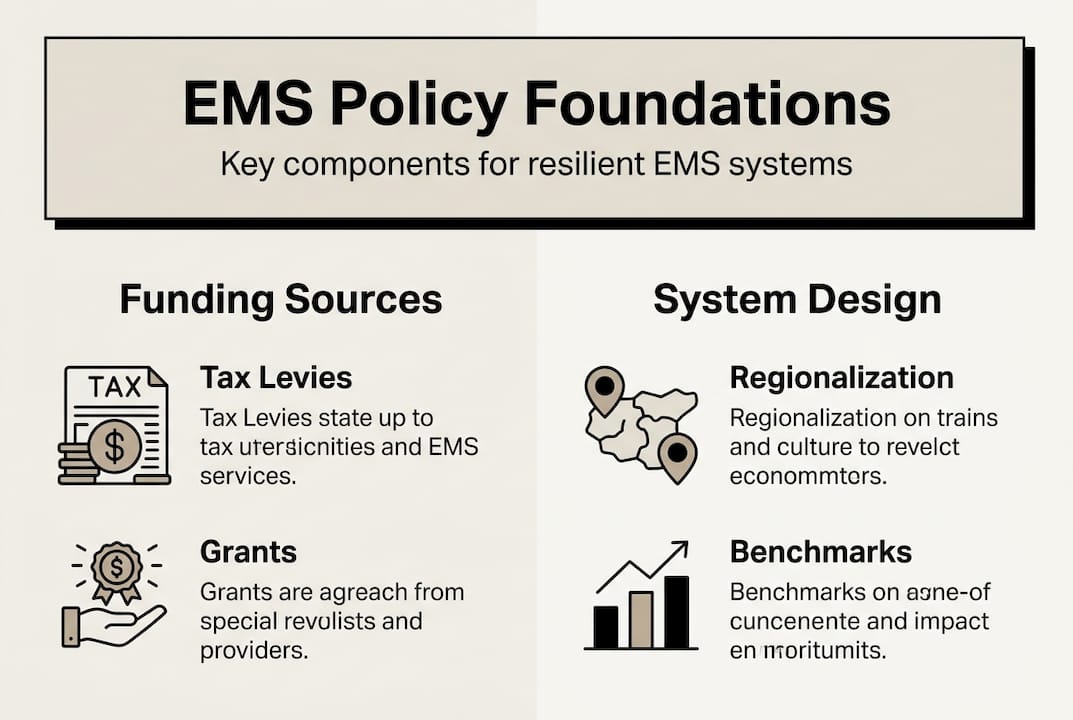
- Funding mechanisms: Tax levies, billing systems, grants, and state allocations
- Oversight and accountability: Quality assurance requirements and reporting mandates
- Regionalization authority: Whether agencies can share resources and protocols across jurisdictions
- Scope of practice: What level of care providers are authorized to deliver
The 11 components for effective systems identified by NHTSA (National Highway Traffic Safety Administration) include regulation and policy, resource management, human resources, medical direction, and evaluation. These components form the basis of state EMS assessments and give municipal leaders a proven framework for optimizing EMS strategy at the local level.
With a shared understanding of what public policy means for EMS, we can examine the funding structures these policies enable or block.
Stable funding: The backbone of strong EMS systems
Funding is where most EMS policy conversations stall. Many municipalities assume that billing revenue will sustain their system. The data tells a different story. Billing reimbursements cover only 20-35% of actual costs, with a typical transport costing around $1,500 while only $490 is recouped. When 80 to 90 percent of transports involve Medicare or Medicaid patients who are chronically under-reimbursed, relying on billing alone is not a funding strategy. It is a path to insolvency.
The two primary revenue sources for EMS systems are tax-based funding and insurance billing. Here is how they compare:
| Revenue source | Stability | Coverage | Community control |
|---|---|---|---|
| Property tax levy | High | Broad | Yes |
| Insurance billing | Low | Partial | No |
| State/federal grants | Medium | Variable | Limited |
| EMS utility fee | High | Broad | Yes |
King County, Washington offers a strong model. Their voter-approved EMS levy is set at $.25 per $1,000 of assessed property value for the 2026 to 2031 period, funding both ALS (Advanced Life Support) and BLS (Basic Life Support) services across the region. This model provides predictable, multi-year revenue that allows for workforce planning, equipment investment, and system-wide coordination.
“The volatility of billing-dependent EMS funding forces agencies into reactive budget cycles, making long-term planning nearly impossible.”
Pro Tip: When building community support for a levy, lead with outcome data. Show residents what response times look like now versus what they could be with stable funding. Voters respond to concrete, local evidence far more than abstract budget arguments. Pair that with transparent cost breakdowns and you will build the trust needed to pass a levy.
For more on building a financially resilient system, explore smart EMS funding strategies that go beyond billing optimization.
Understanding funding stability is only one piece. How you structure your EMS system regionally can make those dollars go further.
Regionalization and system design: Models that work
Regionalization means organizing EMS services across jurisdictional boundaries to share personnel, equipment, protocols, and purchasing power. Done well, it stretches limited resources further and improves consistency of care. Done poorly, it creates bureaucratic gridlock and erodes local control.
EMS regionalization optimizes resources through shared ambulances and personnel, common clinical protocols, and coordinated dispatch. Minnesota’s Primary Service Area (PSA) model is a strong example of flexible regionalization. It assigns geographic service zones while preserving local agency identity and decision-making authority. Compare that to more rigid regulatory environments in states like California and New York, where overlapping jurisdictions and strict licensing requirements can slow innovation and limit collaboration.

| Model type | Flexibility | Local control | Resource efficiency |
|---|---|---|---|
| Minnesota PSA model | High | High | High |
| California/New York rigid model | Low | Low | Medium |
| Informal mutual aid only | Medium | High | Low |
Key benefits of effective regionalization include:
- Reduced duplication of equipment and staffing costs
- Standardized clinical protocols across agencies
- Stronger negotiating power for supply contracts
- Improved coverage during surge events or staffing shortages
- Better data collection for system-wide performance analysis
Pro Tip: Regional collaboration does not require surrendering local identity. Start with shared purchasing agreements or unified dispatch protocols. These low-stakes entry points build trust between agencies before tackling harder questions like shared staffing or consolidated command structures.
You can review EMS system design examples from comparable municipalities, and explore how mutual aid best practices can serve as a foundation for broader regional coordination.
After you select or reform a regional model, ongoing assessment and improvement are critical to keep your EMS policies effective and equitable.
Critical assessment, benchmarks, and continuous improvement
Policy without measurement is guesswork. Strong EMS systems build assessment and quality improvement directly into their governance structure, not as an afterthought but as a standing policy requirement.
NHTSA’s state EMS assessment framework evaluates 11 components, including regulation, resource management, and evaluation processes, to identify gaps and recommend targeted improvements. Municipal leaders should use this framework as a baseline, then layer in local benchmarks that reflect your community’s specific geography, call volume, and demographics.
Vermont’s recent EMS assessment provides a useful reference point. The state recorded an average response time of 10 minutes 36 seconds, with the 90th percentile reaching 17 minutes 34 seconds. The assessment recommended consolidating dispatch and EMS districts to improve oversight and reduce variability. That kind of objective, data-driven evaluation is exactly what effective policy requires.
“Half of Vermont’s EMS agencies are operating at or near unsustainable levels, underscoring the urgent need for objective system evaluation and structural reform.”
Here are the key steps in a structured assessment and improvement cycle:
- Baseline data collection: Gather response time data, call volume by type, unit hour utilization, and mutual aid dependency rates
- Gap analysis: Compare current performance against NHTSA benchmarks and peer system data
- Stakeholder input: Engage medical directors, agency leaders, and elected officials in interpreting findings
- Policy recommendations: Translate gaps into specific, actionable policy changes with timelines
- Implementation tracking: Assign accountability and set measurable milestones for each recommendation
- Annual review: Revisit benchmarks each year and conduct a full reassessment every three to five years
A thorough EMS needs assessment is the starting point for this cycle, and a well-structured EMS strategic planning process ensures those findings translate into durable policy. For a step-by-step breakdown, review the system assessment steps we recommend for municipal leaders.
With these pillars in place, municipal leaders must put policy into strategic action.
Policy implementation: Tools, consulting, and next steps
Knowing what good EMS policy looks like is one thing. Building the political will and operational capacity to implement it is another. Here are the practical steps that move policy from concept to reality:
- Form a policy committee: Bring together EMS directors, municipal finance officers, medical directors, and elected officials to own the policy agenda
- Engage voters early: For levy campaigns, start community education 12 to 18 months before the ballot. Transparency builds trust.
- Request a state or NHTSA assessment: Use the formal assessment process to generate objective findings that carry political weight
- Develop a written EMS plan: The Connecticut State EMS Plan sets a clear standard: every municipality should have a written EMS plan that includes mutual aid agreements and QA/QI (Quality Assurance and Quality Improvement) processes
- Explore EMS utility structures: Some municipalities fund EMS through a utility fee model, which provides stable revenue without requiring repeated voter approval
- Leverage outside expertise: Consultants who specialize in EMS system design bring benchmarking data, legislative knowledge, and implementation experience that internal teams often lack
King County’s regional policy committee structure and multi-year strategic planning cycle are worth studying. Their approach to voter levy campaigns, combined with transparent performance reporting, has sustained public support across multiple election cycles. That kind of institutional trust does not happen by accident. It is built through consistent, policy-driven accountability.
Working with expert EMS consulting partners ensures that your implementation plan is grounded in real-world data and tailored to your community’s specific needs, not a generic template.
Transform EMS policy into action with expert support
The frameworks in this guide give you a clear picture of what strong EMS policy looks like. Translating that picture into a functioning, funded, and accountable system requires structured support and proven methodology. That is where we come in.

At The Public Safety Consulting Group, we work alongside municipal leaders to design EMS systems that are financially sustainable, regionally coordinated, and continuously improving. Whether you need help structuring a levy campaign, conducting a performance gap analysis, or building a multi-year strategic plan, we bring the expertise and the data to move your system forward. See EMS system design examples from municipalities like yours, get help assessing your EMS needs with a structured evaluation, or optimize your EMS strategy with a customized roadmap built around your community’s goals. Let’s build something that lasts.
Frequently asked questions
What is the most stable EMS funding model for municipalities?
Voter-approved tax levies provide stability and predictability that billing or insurance reimbursement cannot match, making them the preferred long-term funding foundation for most municipal EMS systems.
How often should EMS systems conduct assessments and updates?
NHTSA and state best practices recommend a full system assessment every 3 to 5 years, with annual reviews of response benchmarks and quality improvement measures to track progress between full evaluations.
What are the consequences of relying only on billing reimbursement for EMS?
Billing reimbursement alone typically covers just 20 to 35% of costs, leaving a significant funding gap that makes services financially unsustainable without tax subsidies or other stable revenue sources.
How can rural areas develop effective EMS policies?
Flexible regionalization with shared resources and mutual aid agreements consistently outperforms rigid regulatory approaches in rural settings, where geography and low call volume make standalone agency models difficult to sustain.