



EMS administrators face complex challenges every day: staffing shortages, budget constraints, evolving protocols, and the constant pressure to deliver high-quality emergency care. Many leaders find themselves promoted into management roles based on clinical excellence, yet lack formal leadership training to guide diverse teams through these operational demands. Without structured development, skill gaps emerge that affect team morale, response times, and service quality. This guide provides EMS leaders with a comprehensive framework to build essential competencies, adopt effective leadership styles, and implement practical development strategies that drive measurable improvements in organizational performance and staff satisfaction.
Table of Contents
- Key takeaways
- Understanding EMS leadership roles and competencies
- Core EMS leadership styles and effective communication strategies
- Methods to develop EMS leadership skills and measure progress
- Applying leadership skills to improve EMS operational effectiveness
- Explore expert EMS leadership solutions
- Frequently asked questions
Key Takeaways
| Point | Details |
|---|---|
| Leadership levels | Identify your EMS officer level to target development efforts. |
| Seven competency pillars | Use the seven pillars as a structured progression from prerequisites to organizational stewardship to guide learning. |
| Align development with level | Tailor training and experiences to the leadership level you occupy for maximum impact. |
| Leadership styles and EQ | Apply servant and authentic leadership and strengthen communication and emotional intelligence to improve team performance. |
| Practical development tools | Incorporate mentorship, structured feedback, and formal education programs to drive improvements. |
Understanding EMS leadership roles and competencies
Effective leadership development starts with understanding where you fit in your organization’s structure. NEMSMA defines three levels of EMS officers: supervising officers who provide first-line leadership to field crews, managing officers who coordinate multiple units and oversee tactical operations, and executive officers who set strategic direction and manage organizational resources. Each level demands distinct competencies, and recognizing your current position helps you target development efforts precisely.
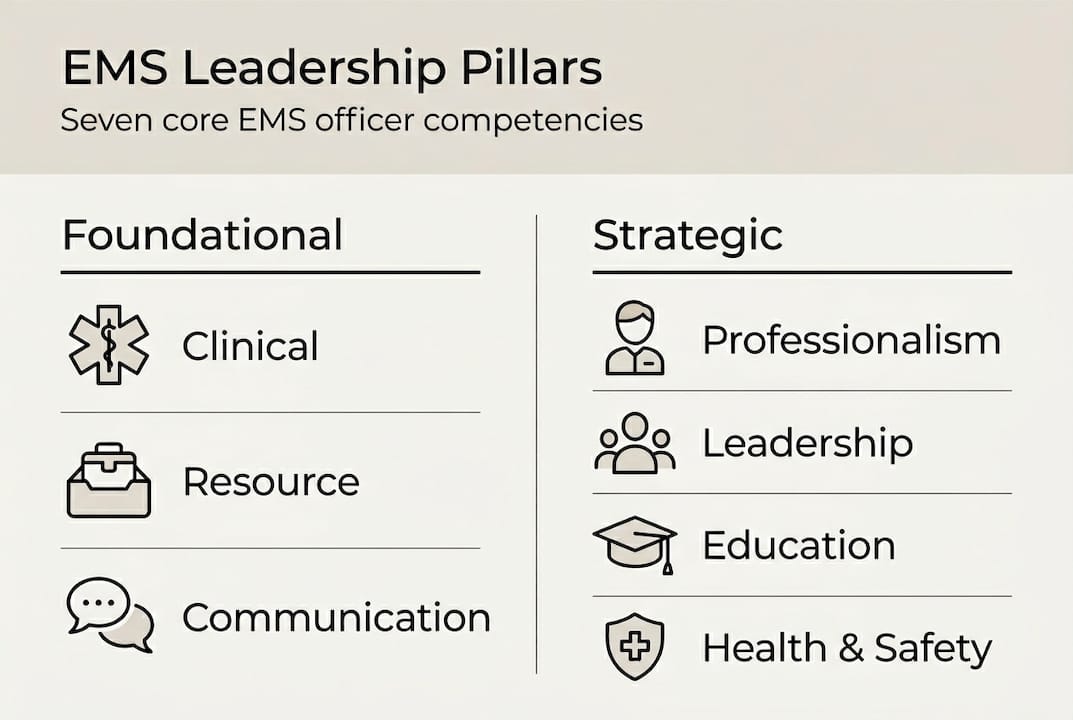
The seven pillars of EMS Officer Competencies provide a proven framework for building leadership capabilities. These pillars create a structured pathway from foundational prerequisites through advanced organizational stewardship. Understanding how these EMS officer competency pillars interconnect helps you build a comprehensive development plan rather than pursuing random training opportunities.
| Leadership level | Core responsibilities | Key focus areas |
|---|---|---|
| Supervising officer | Direct crew oversight, shift management, immediate tactical decisions | Communication, conflict resolution, performance feedback |
| Managing officer | Multi-unit coordination, resource allocation, policy implementation | Strategic planning, budget management, cross-functional collaboration |
| Executive officer | Organizational vision, stakeholder relations, system-wide strategy | Governance, community engagement, long-term sustainability |
The competency pillars encompass critical domains that span all leadership levels:
- Prerequisites: Foundational knowledge including EMS operations, legal frameworks, and industry standards
- Self attributes: Personal qualities like emotional intelligence, ethical decision-making, and continuous learning commitment
- Leading others: Skills in motivation, delegation, conflict management, and team development
- Task management: Operational competencies including resource allocation, quality assurance, and performance monitoring
- Innovation: Capacity for creative problem-solving, technology adoption, and process improvement
- Social responsibility: Community engagement, cultural competence, and public health awareness
- Organizational stewardship: Strategic planning, financial management, and sustainability focus
Each pillar contains specific EMS officer competencies that progress in complexity as you advance through leadership levels. A supervising officer might focus on basic team communication and shift documentation, while an executive officer develops board relations and legislative advocacy skills. The pillars remain constant, but your depth of mastery grows with experience and intentional development.
Pro Tip: Align your development activities with the specific leadership level you occupy to maximize impact. Supervising officers benefit most from tactical communication and crew management training, while executives should prioritize strategic planning and stakeholder engagement skills.
Core EMS leadership styles and effective communication strategies
Leadership style significantly influences how your team responds to challenges and embraces organizational goals. Research on leadership foundations for EMS leaders identifies five core approaches that work particularly well in emergency services environments. Each style offers unique advantages depending on situational demands and team dynamics.
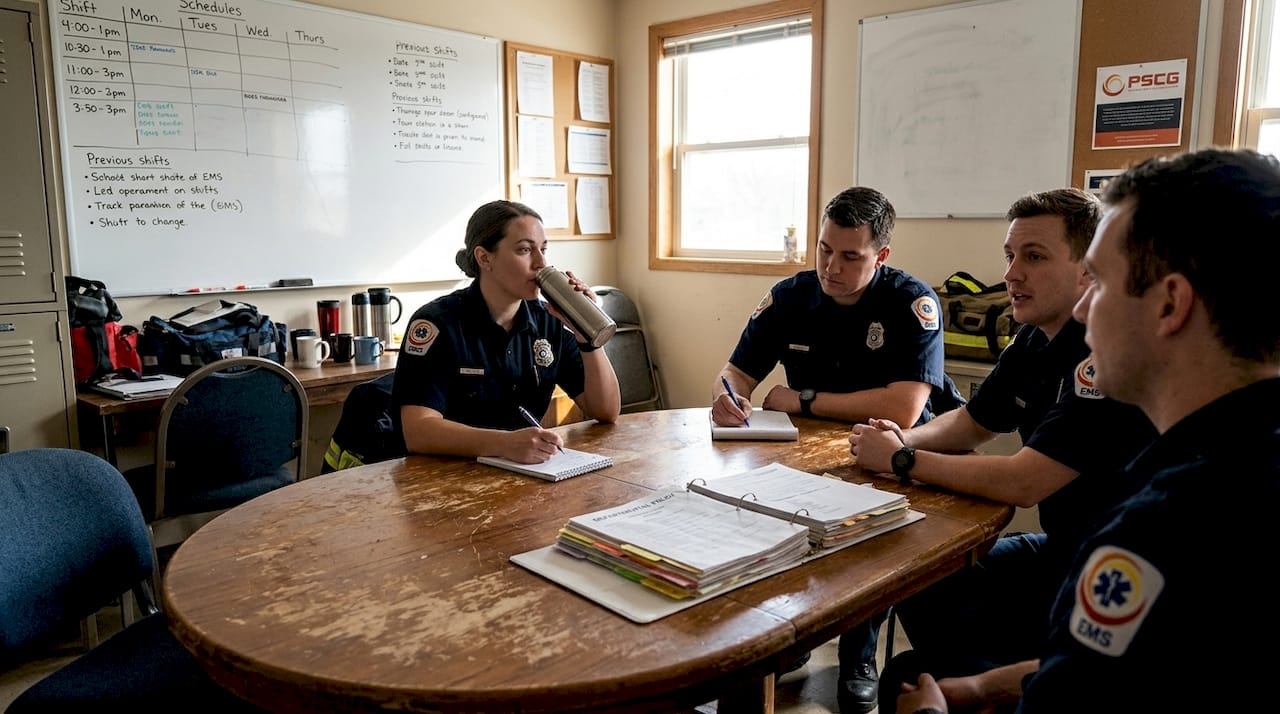
Servant leadership prioritizes team member growth and well-being, creating a supportive culture where staff feel valued and empowered. This approach works exceptionally well during periods of organizational change or when rebuilding trust after challenging incidents. Authentic leadership emphasizes transparency, ethical behavior, and genuine relationships, building credibility through consistent actions that match stated values. This style strengthens organizational culture and improves staff retention by creating psychological safety.
Transformational leadership inspires teams through compelling vision and high expectations, driving innovation and performance improvements. Adaptive leadership enables flexible responses to complex, evolving challenges by encouraging experimentation and learning from setbacks. Autocratic leadership provides clear direction and rapid decision-making during high-stakes emergencies when immediate action is required without deliberation.
Knowing when to apply each style maximizes effectiveness:
- Use servant leadership when developing new supervisors or supporting staff through personal challenges
- Apply authentic leadership during organizational transitions or when rebuilding credibility after setbacks
- Deploy transformational leadership when launching new initiatives or pursuing significant operational improvements
- Leverage adaptive leadership for complex problems without clear solutions, like managing chronic staffing shortages
- Employ autocratic leadership during active emergencies or critical incidents requiring immediate coordinated response
Effective communication amplifies leadership impact by ensuring messages reach the right people at the right time through appropriate channels. Creating a structured public safety communication plan prevents information gaps and builds stakeholder trust. EMS communication planning techniques emphasize intentional design rather than reactive messaging.
Follow these steps to build your communication framework:
- Define objectives: Clarify what you need to accomplish through communication, whether informing staff about policy changes, engaging community stakeholders, or coordinating with hospital partners
- Map stakeholders: Identify all groups requiring communication, including field crews, administrative staff, medical directors, municipal officials, hospital partners, and community members
- Select channels: Choose appropriate methods for each audience, such as shift briefings for crews, email updates for administrative staff, and public meetings for community engagement
- Establish cadence: Determine frequency for each communication type, balancing information needs against message fatigue
- Create feedback loops: Build mechanisms for two-way dialogue, including suggestion systems, town halls, and regular check-ins that invite questions and concerns
- Monitor effectiveness: Track whether messages reach intended audiences and produce desired outcomes, adjusting approach based on results
Pro Tip: Use adaptive leadership style to respond to dynamic EMS challenges effectively. When facing unpredictable situations like pandemic response or sudden budget cuts, adaptive leaders experiment with solutions, gather feedback quickly, and adjust approaches based on real-world results rather than sticking rigidly to predetermined plans.
Methods to develop EMS leadership skills and measure progress
Transforming leadership potential into demonstrated competency requires intentional development strategies supported by proven methodologies. EMS leadership development resources and tools provide multiple pathways for skill building, each offering distinct advantages depending on your learning style, available resources, and specific development goals.
| Development method | Strengths | Best applications | Resource examples |
|---|---|---|---|
| Mentorship programs | Personalized guidance, relationship building, context-specific advice | New supervisors, role transitions, complex challenges | NEMSMA mentorship network, state EMS associations |
| SMART goal planning | Clear targets, measurable progress, accountability structure | Systematic skill development, performance improvement | Individual development plans, annual leadership objectives |
| 360-degree feedback | Multi-perspective insights, blind spot identification, comprehensive assessment | Periodic skill evaluation, behavior change validation | Anonymous surveys, structured peer reviews |
| Continuing education | Formal knowledge acquisition, credential advancement, structured curriculum | Foundational competencies, certification requirements | FEMA Emergency Management Institute, NREMT courses |
| Leadership academies | Intensive immersion, peer networking, expert instruction | Accelerated development, career advancement preparation | State fire academies, EMS leadership institutes |
SMART goals provide the foundation for measurable leadership development by transforming vague aspirations into concrete targets. Implement this approach through structured planning:
- Specific: Define precisely what you will accomplish, such as “Complete FEMA ICS-300 course and apply incident command principles to manage three multi-agency incidents” rather than “Improve emergency management skills”
- Measurable: Establish clear metrics for success, like “Reduce average unit hour utilization from 0.52 to 0.45 through improved scheduling” instead of “Better manage resources”
- Achievable: Set challenging but realistic targets given current constraints, balancing ambition with available time and resources
- Relevant: Align goals with organizational priorities and your leadership level responsibilities, ensuring development efforts support broader strategic objectives
- Time-bound: Assign specific deadlines creating urgency and enabling progress tracking, such as quarterly milestones within annual development plans
Ongoing feedback mechanisms keep development efforts aligned with actual performance needs. Traditional annual reviews provide insufficient information for continuous improvement. Instead, implement regular 360-degree feedback gathering input from supervisors, peers, and direct reports on specific competencies. This multi-perspective approach reveals blind spots and validates progress in ways self-assessment cannot.
Structure feedback collection around the seven competency pillars, asking respondents to rate observable behaviors rather than general impressions. For example, assess “Provides clear expectations and actionable guidance during shift briefings” rather than “Is a good communicator.” Specific behavioral feedback enables targeted improvement efforts.
EMS leadership development methods work best in combination rather than isolation. Pair formal education with mentorship to apply new concepts in your specific context. Supplement SMART goals with regular feedback to validate you’re developing skills that others observe and value. Track completion of development activities alongside performance metrics to demonstrate return on investment.
Pro Tip: Regularly review and adjust development plans based on feedback and performance metrics to stay on track. Schedule quarterly self-assessments examining progress toward annual goals, soliciting input from trusted colleagues about observed changes, and modifying plans when organizational priorities shift or new development needs emerge.
Applying leadership skills to improve EMS operational effectiveness
Developing leadership competencies delivers measurable value when translated into improved organizational performance. The connection between leadership quality and operational outcomes is well-documented across healthcare and emergency services. Transformational leadership explains 81.4% variance in organizational resilience among healthcare organizations, demonstrating how leader behaviors directly influence an organization’s capacity to withstand challenges and maintain service quality during disruptions.
Transformational leadership explains 81.4% variance in organizational resilience in healthcare including EMS.
This finding has profound implications for EMS agencies facing chronic stressors like staffing shortages, budget constraints, and increasing call volumes. Leaders who inspire shared vision, challenge processes, and support individual development create organizations better equipped to adapt and thrive despite external pressures. The competencies you build through intentional development directly strengthen your agency’s operational resilience.
Specific operational benefits emerge from strong leadership:
- Staff retention: Leaders who demonstrate authentic care and create growth opportunities reduce turnover, preserving institutional knowledge and reducing recruitment costs
- Communication effectiveness: Structured communication planning improves coordination during complex incidents and strengthens relationships with hospital and municipal partners
- Response quality: Clear expectations, regular feedback, and supportive coaching elevate field performance and clinical outcomes
- Innovation adoption: Leaders who encourage experimentation and learning from failures accelerate implementation of new technologies and protocols
- Resource optimization: Strategic planning skills enable better budget management and more efficient resource allocation
Adaptive EMS leadership proves particularly valuable for navigating complex challenges without clear solutions. Unlike technical problems with known fixes, adaptive challenges require changing behaviors, priorities, or beliefs. Chronic understaffing, for example, cannot be solved through simple hiring; it demands creative scheduling, expanded scope of practice, community paramedicine programs, or other innovations that challenge traditional service delivery models.
Adaptive leaders mobilize their organizations to confront these difficult realities by creating safe spaces for honest dialogue about challenges, protecting voices of dissent who question status quo assumptions, and regulating distress so teams can work productively without becoming overwhelmed. This approach enables organizations to develop novel solutions rather than repeatedly applying ineffective traditional responses.
Integrating leadership development with EMS strategic planning process creates sustained operational improvements. Strategic plans establish organizational direction, while leadership competencies provide the skills to execute those plans effectively. Leaders who can articulate compelling vision, engage stakeholders, manage change, and monitor progress transform strategic documents into operational reality.
Measure leadership impact through concrete operational metrics rather than subjective assessments. Track changes in staff turnover rates, employee satisfaction scores, response time performance, clinical quality indicators, budget variance, and community satisfaction following leadership development initiatives. These objective measures demonstrate return on investment and identify areas requiring additional focus.
Explore expert EMS leadership solutions
Building leadership capabilities requires commitment, but you don’t have to navigate this journey alone. The PSC Group specializes in helping EMS agencies strengthen leadership effectiveness through tailored consulting and development programs. Our team brings decades of experience in EMS strategic planning process, system design, and operational improvement to support your growth as a leader.
Whether you’re developing a comprehensive strategic plan, redesigning service delivery through EMS system design examples, or building leadership capacity across your organization, our public safety leadership services provide the expertise and support you need. We work alongside EMS administrators to translate leadership competencies into operational excellence, creating sustainable improvements that strengthen your agency’s resilience and service quality.
Frequently asked questions
What are the main leadership levels in EMS?
EMS leadership operates across three distinct tiers, each requiring progressively advanced competencies. Supervising officers provide first-line leadership managing daily crew operations and immediate tactical decisions. Managing officers coordinate multiple units, oversee mid-level operations, and implement organizational policies across shifts or divisions. Executive officers set strategic direction, manage stakeholder relationships, and guide long-term organizational sustainability through governance and resource stewardship.
How can EMS leaders choose the best leadership style?
Selecting an effective leadership approach requires assessing both situational demands and team needs. Evaluate whether the situation demands rapid decision-making, collaborative problem-solving, or inspirational motivation, then choose among servant, authentic, transformational, adaptive, or autocratic styles accordingly. Adaptive and transformational styles often benefit dynamic EMS environments most because they enable flexible responses to complex challenges while inspiring teams toward continuous improvement. The most effective leaders develop capacity across multiple styles, applying each situationally rather than defaulting to a single approach.
What tools support EMS leadership development?
Proven development tools include mentorship programs pairing emerging leaders with experienced guides, SMART goal planning that creates measurable targets, 360-degree feedback gathering multi-perspective performance insights, FEMA and NREMT courses building foundational competencies, and leadership academies providing intensive skill immersion. Each tool offers unique benefits, but combining multiple methods accelerates development more effectively than relying on any single approach. The most successful leaders integrate formal education with experiential learning, regular feedback, and ongoing mentorship throughout their careers.
How does leadership affect EMS operational outcomes?
Strong leadership correlates directly with higher organizational resilience, improved emergency response quality, and better staff retention in EMS agencies. Research demonstrates that transformational leadership accounts for over 80% of variance in organizational resilience, showing how leader behaviors influence an agency’s capacity to maintain service quality during disruptions. Effective leaders create cultures of continuous improvement, psychological safety, and shared accountability that elevate team performance and clinical outcomes while reducing turnover costs and operational inefficiencies.
Recommended
- How to Build Public Safety Leadership for EMS Success
- 7 Essential Public Safety Leadership Tips for EMS Leaders
- EMS Strategic Planning Process for Successful Service Delivery
- Best Practices for EMS Instructors: Shaping the Future of Emergency Medical Services Education | The Public Safety Consulting Group
- EMS Background Checks Cut Negligent Hiring 40% in 2026