

By Michael A. Loiz, EMS Chief and Public Safety Advocate
For decades, C-MED centers have served as the backbone of regional EMS communications. In their prime, these centers revolutionized interoperability—bridging field providers, hospitals, and medical control through a single communications hub.
But as digital platforms, telemedicine, and data-driven coordination redefine modern EMS, these centers are facing a reckoning. Many are struggling with outdated infrastructure, unsustainable costs, and operational models that haven’t evolved in decades.
“The question isn’t whether C-MED is still relevant—it’s whether it can afford not to change.”
The Problem: Legacy Systems at Unsustainable Costs
The infrastructure was built for a 1970s model of EMS. Yet many centers still rely on the same analog workflows—manual patching, handwritten logs, and voice-only communications—while demanding ever-increasing support from the very EMS agencies struggling to stay financially afloat.
The cost of stagnant technology has simply outpaced its value. With EMS reimbursement rates at crisis levels, agencies can no longer justify paying into systems that provide minimal operational return.
It’s time to reform the pricing structure. Fees must reflect the value of modern services—data interoperability, telemedicine support, or system coordination—not legacy access charges for outdated radio channels. Without reform, the economic imbalance will continue to punish the very agencies that were designed to be served.
“EMS shouldn’t be forced to bankroll outdated tech simply because it’s always been that way.”
The Opportunity: Reinvention Through Innovation
C-MED: The Key to Future-Ready Emergency Services
These centers occupy a pivotal position—connecting field providers, hospitals, and oversight agencies. With modernization, they could evolve into Regional Medical Communications and Coordination Hubs, providing far more than just “patches.”
1. Embrace Mobile Integrated Healthcare (MIH)
C-MEDs can play a vital role in the emerging MIH model. By coordinating community paramedics and nurse practitioners for low-acuity calls, they can reduce unnecessary transports and align with value-based care goals.
A forward-looking C-MED could track MIH units in real time, dispatch them to non-emergent 911 calls, and interface directly with local public health agencies.
2. Integrate Nurse Triage and Telemedicine
Next-generation centers can host tele-triage and telehealth services, offering direct clinician access to field providers. Rather than a one-way patch to an ED, they can facilitate video-enabled medical direction, alternate destination decisions, and treatment-in-place models—all improving efficiency and patient outcomes.
3. Consolidate to Achieve Scale and Efficiency
One of the most glaring inefficiencies in the current system is fragmentation. Some of the smallest states in the nation operate as many—or more—C-MED centers as the largest ones. Each center duplicates infrastructure, staffing, and costs, all while competing for limited EMS dollars.
It’s time to consolidate. A smaller number of well-equipped, interoperable centers could deliver higher-quality service, reduce administrative costs, and improve regional coordination—without sacrificing local identity.
4. Stay in the Vendor Lane
C-MEDs are vendors, not governing authorities. Their role is to support EMS communications—not to direct agency policy or operations.
When an organization uses access or frequency control as leverage against EMS providers—or bans agencies from radio use due to personal or political disputes—it crosses a dangerous line. Such actions risk legal exposure, liability, and potentially violate federal communications law by obstructing public safety operations.
“C-MED’s duty is clear: support the customer—the EMS system—without interference or ego.”
5. Build the Future, Not Barriers
The next evolution lies in data integration, not voice control. Modern centers can become real-time hubs for CAD, ePCR, hospital EMR, and regional situational awareness—creating a unified operational picture for EMS and public health alike.
By embracing AI-assisted triage, predictive analytics, and telehealth integration, C-MED can once again become indispensable—not for nostalgia, but for innovation.
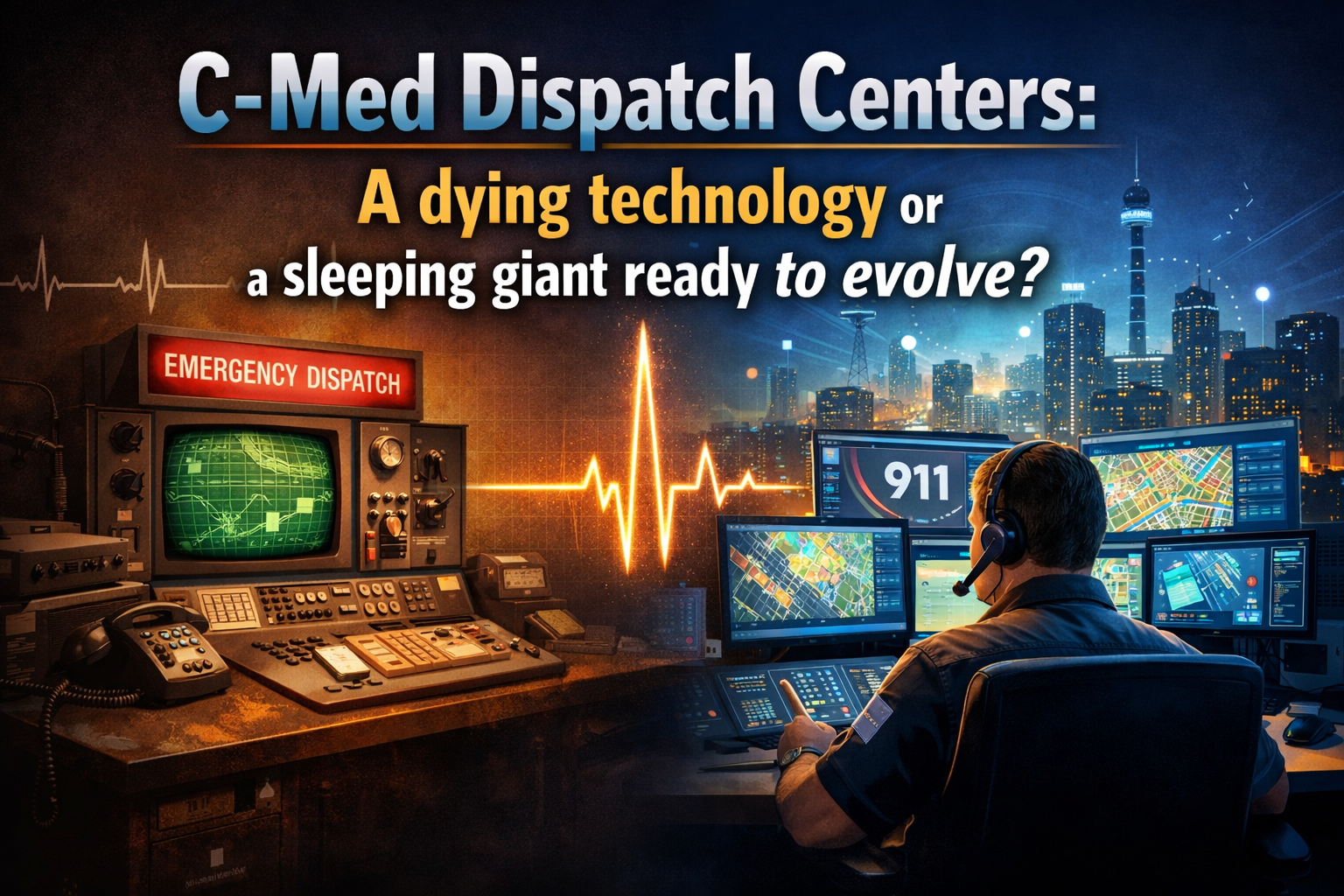
C-MED Centers once defined EMS innovation. But their survival now depends on their willingness to modernize, consolidate, and redefine their mission.
If they continue charging premium fees for outdated technology, resisting reform, or inserting themselves into EMS operations beyond their contractual role, they will simply price themselves—and their communities—out of existence.
The EMS industry has already moved toward telemedicine, integrated data, and intelligent dispatch. Those who refuse to evolve will be left behind.
“If your C-MED can’t deliver value beyond a radio patch, it’s not a communications center—it’s an expense we can no longer afford.”
They can still be part of the future—but only if they are willing to become something new. Many centers are already pursuing this approach. The EMS system in most areas of the country do not want to see the current system die out, they want to see them evolve and keep up with the fast pace evolution of EMS, so that they remain relevant and useful to our common goals.
About the Author
Michael A. Loiz is an EMS Chief and Public Safety Advocate based in Connecticut. With over 25 years of experience in emergency services leadership, he focuses on system design, communications reform, and the modernization of public safety operations.
References
- National Highway Traffic Safety Administration (NHTSA), EMS Communications Systems: Technical Assistance and Guidance for Interoperability, U.S. DOT, 2023.
- National Association of State EMS Officials (NASEMSO), Model EMS System Standards: Communications & Medical Direction Section, 2022.
- Centers for Medicare & Medicaid Services (CMS), ET3 Model Overview: Emergency Triage, Treat, and Transport, 2023.
- National Emergency Number Association (NENA), Next Generation 9-1-1 and the Future of EMS Interoperability, 2024.
- National Association of EMS Physicians (NAEMSP), Position Paper: Mobile Integrated Healthcare and EMS System Coordination, 2023.
- Federal Communications Commission (FCC), Public Safety and Homeland Security Bureau: Public Safety Radio Systems Guidance, 2022.
Want to learn more about how PSCG can assist your CMED or Dispatch center? Click here to learn more or Contact us today